

Overview
Galaxy is the semantic layer for modern organizations. It sits above your existing data systems and captures what your organization knows about itself: what entities exist, how they relate, what they mean, and how those meanings map back to real systems. Galaxy turns fragmented databases, tools, and pipelines into a shared, navigable context graph. This is not analytics. It is not dashboards. It is not just metadata. Galaxy is where structure becomes understanding.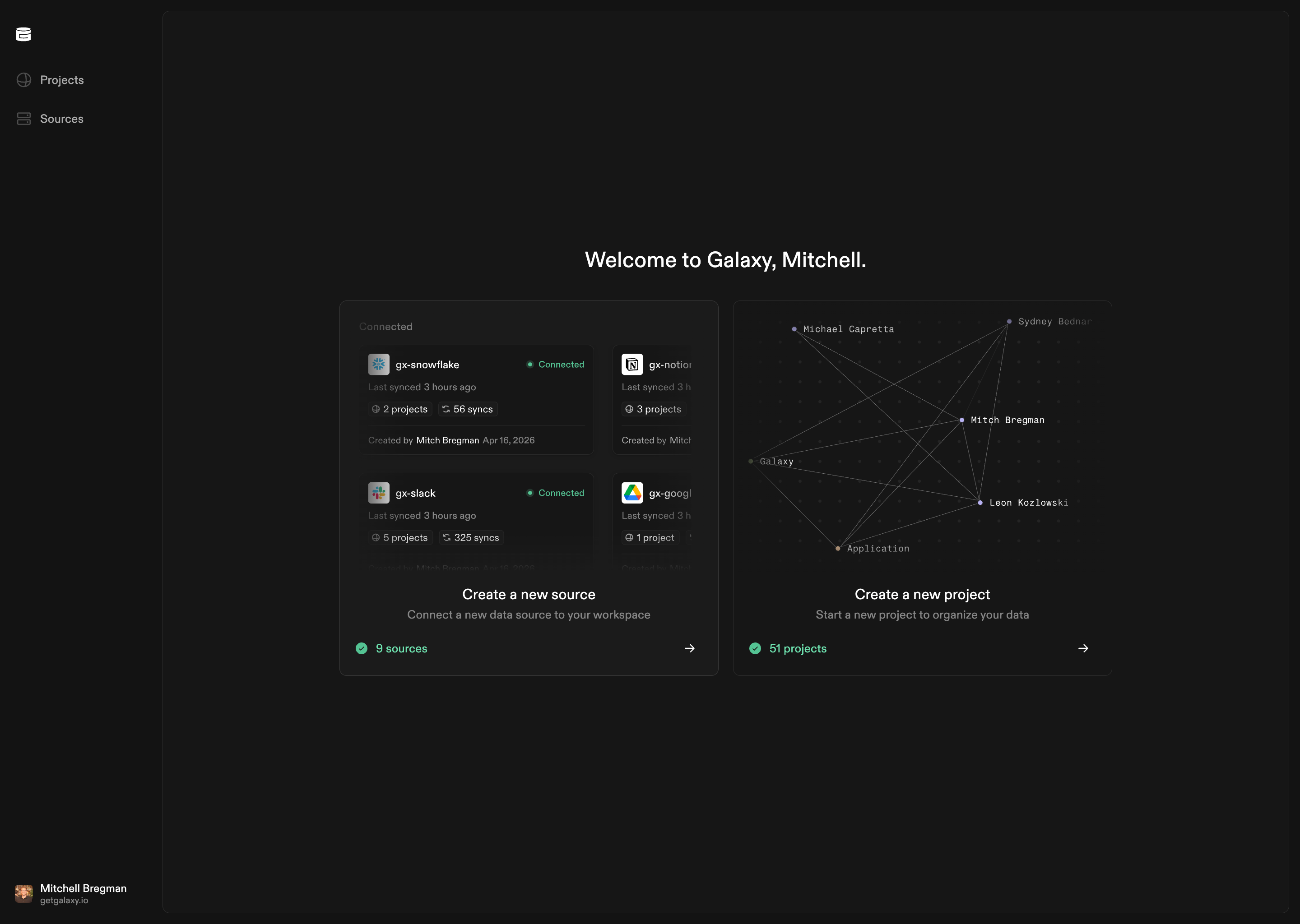
The Problem Galaxy Solves
Every growing organization eventually hits the same wall: Data is everywhere, but understanding is nowhere. Modern organizations are not struggling because they lack data. They are struggling because they lack shared understanding. Over the last decade, companies invested heavily in data warehouses, ETL tools, BI dashboards, metrics layers, reverse ETL, and AI systems. This produced an abundance of data and tooling, but it also produced fragmentation. Each system encodes its own partial truth. Each team develops its own mental model. Each database reflects only one slice of the organization. Meaning lives in engineers’ heads, Slack threads, old docs, and tribal memory. The same concept exists under different names across systems. New hires take months to build a mental map. AI initiatives stall because there is no shared context to reason over. What’s missing is a unifying semantic layer that answers the most fundamental questions:- What entities exist in this business?
- What do they actually represent?
- How do they relate across systems?
- Where does meaning live when schemas change?
- How do humans and AI reason about the same world?
What Galaxy Is
Galaxy is semantic infrastructure. At the product level, Galaxy is a platform that helps organizations understand themselves. It observes the systems they already run, captures shared meaning about what exists inside them, and turns that meaning into a navigable, durable context graph that both humans and machines can reason over. At the infrastructure level, Galaxy is building the missing layer of the modern data stack: the ontology and context layer that sits above fragmented tools and below applications, analytics, and AI. Galaxy does not move data. Galaxy does not replace systems. Galaxy makes systems coherent.What Galaxy Actually Does
Galaxy connects to an organization’s existing data systems and observes their structure:- Schemas
- Tables
- Fields
- Types
- Relationships as expressed in databases
- Entities: customers, users, accounts, devices, incidents, policies
- Concepts: identity, ownership, lifecycle, responsibility
- Relationships: belongs to, represents, depends on, derives from
What Galaxy Is Not
Galaxy is intentionally not:- A BI or dashboarding tool
- A reporting or metrics layer
- A data warehouse or storage engine
- A rules engine or transformation system
- What happened?
- What’s the number?
- How do I query this table?
- What is a “customer” in this company?
- How does identity flow across systems?
- Where does truth originate?
- How do systems, people, and processes interlock?
- What does this organization actually know?
Why Ontology Is the Right Abstraction
Most systems only capture structure. Tables, columns, schemas, fields. These describe how data is stored, not what it represents. Databases describe storage. APIs describe transport. Dashboards describe outputs. Ontology describes meaning. Ontology is the missing layer. It gives names to things that already exist but are otherwise implicit:- The same “user” represented in five systems
- The same “account” modeled differently by Sales, Finance, and Ops
- The same lifecycle expressed across events, states, and tables
- A
user_idis just a string - A
statuscolumn has no shared interpretation - A “customer” means something different in every system
- Schema changes break understanding
- AI models hallucinate semantics
- Teams argue endlessly over definitions
- Context leaks as people leave
Why Context Graphs Are the Natural Representation
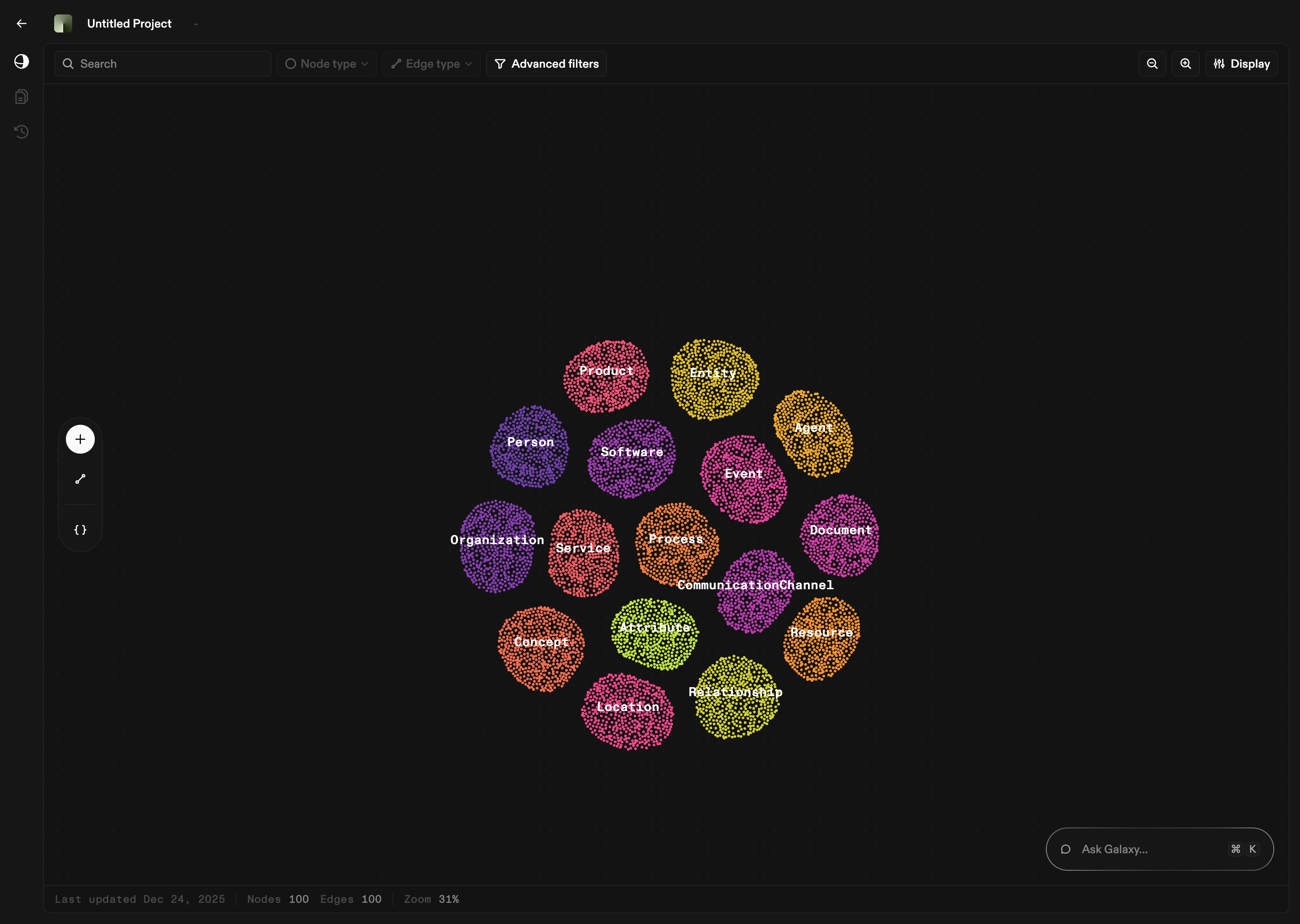
Organizations don’t operate as tables. They operate as graphs. Organizations are not hierarchical. They are not flat. They are not tabular. They are graphs. People interact with systems. Systems generate events. Events affect entities. Entities evolve through lifecycles. Galaxy models this reality directly. Instead of forcing everything into flat documentation or isolated schemas, Galaxy builds context graphs that show how things relate across boundaries:- Across databases
- Across teams
- Across tools
- Across time
- See how things relate across boundaries
- Traverse systems the way humans think
- Preserve nuance that flat schemas destroy
- Reason across time and ownership
- Visual: See relationships at a glance
- Navigable: Explore connections interactively
- Queryable: Ask questions about structure and meaning
- Evolvable: Update as understanding grows
How Galaxy Fits Into Your Stack
Galaxy sits between systems, not inside any single one. It connects to your existing infrastructure as sources of truth and builds understanding above them.Alongside Databases and Warehouses
Galaxy observes schemas, tables, and fields without copying or migrating data. It reflects reality as it exists today.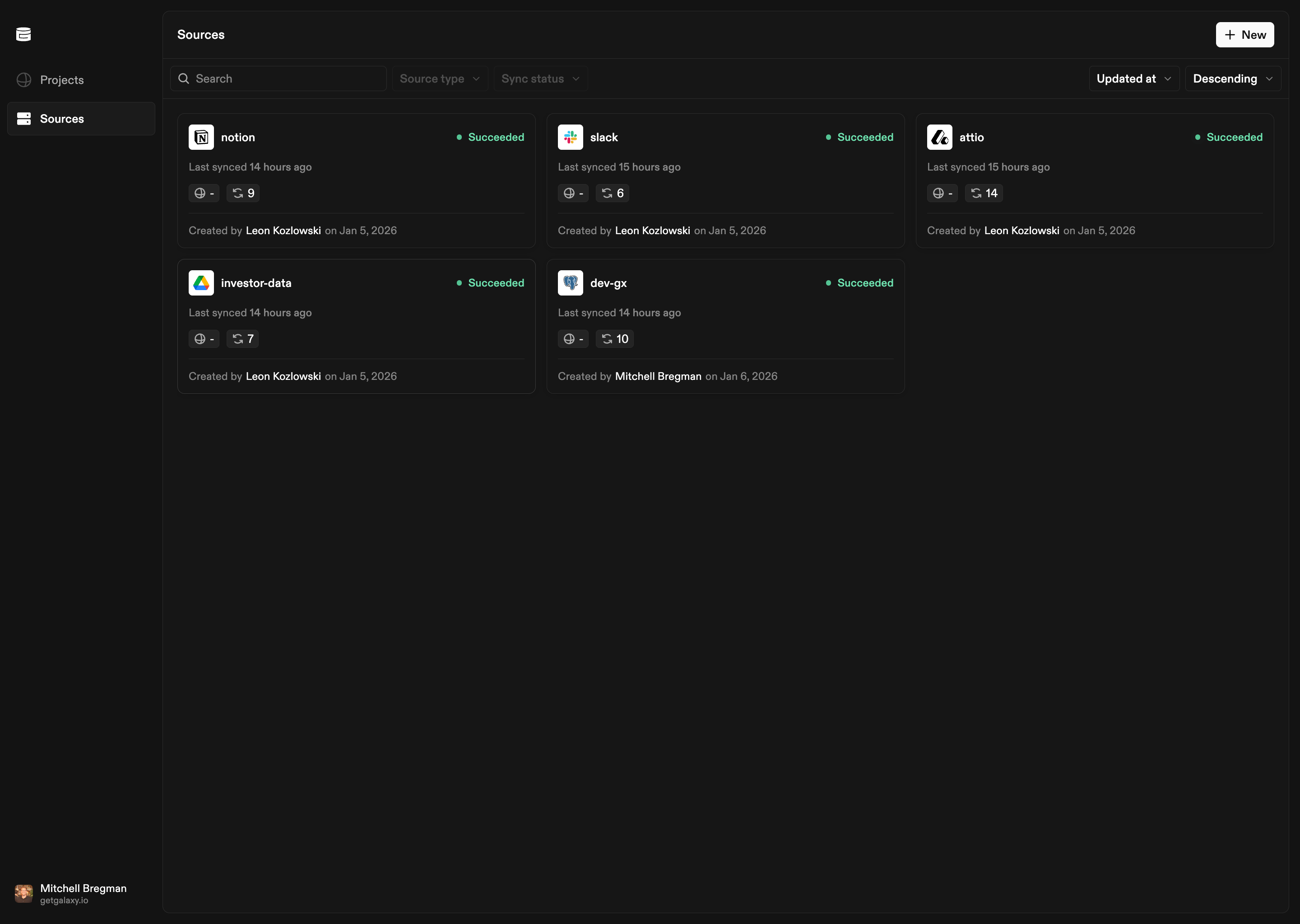
Alongside BI Tools
BI tools answer analytical questions. Galaxy provides the semantic foundation that makes those answers interpretable and consistent.Beyond Data Catalogs
Catalogs inventory assets. Galaxy models meaning and relationships. Inventory is static. Ontology is alive.Beyond Documentation
Docs rot. Galaxy stays connected to systems. When systems change, understanding can change with them. Galaxy is the semantic control plane of your data universe.Why Galaxy Matters Right Now
Galaxy is not early. It’s late. Three forces are converging: 1. The Modern Data Stack Has Fragmented Too Far Best-of-breed tooling created a maintenance nightmare. Understanding no longer lives in any single place. 2. AI Has Exposed the Cost of Missing Context AI systems amplify ambiguity. Without shared semantics, they fail in unpredictable ways. 3. Organizations Are Hitting Coordination Limits As teams scale, knowledge stops compounding. Galaxy restores compounding understanding. Galaxy exists because the next decade of software will not be built on raw data alone. It will be built on meaningful structure.Core Concepts
Galaxy is built around three foundational concepts: Sources, Projects, and Workspace Settings.Sources: Observing Reality
Sources represent the systems where data lives today. Databases, warehouses, operational stores. A Source answers one question: What exists? Sources are purely observational:- Schemas
- Tables
- Fields
- Types
Projects: Defining Meaning
Projects are where ontology lives. A Project is a semantic context graph that sits on top of one or more Sources. Inside a Project, teams:- Define entities and concepts
- Describe how those entities relate
- Map semantic concepts back to real data
- Visualize systems as a connected whole
- Evolve understanding over time
Workspace Settings: Governing Context
Workspace Settings define how Galaxy operates across the organization:- Access and permissions
- Team management
- User preferences
How Sources and Projects Work Together
Galaxy intentionally separates observation from interpretation.- Sources observe reality: Galaxy connects to systems and records what exists, without opinion.
- Projects interpret reality: Teams define what those structures mean in context.
- Graphs emerge naturally: As entities and relationships are defined, a navigable graph forms.
- Understanding evolves: When systems change, the ontology can evolve with them.
Why This Layer Becomes Critical for AI
AI systems don’t struggle with data volume. They struggle with context. Without ontology:- Models hallucinate meaning
- Agents can’t reason across systems
- Automation breaks at semantic boundaries
- AI agents
- Automated reasoning
- System-wide intelligence
- Organizational digital twins
Who Galaxy Is For
Galaxy is built for organizations that are past their “single system” phase:- Scaleups with real data complexity
- Enterprises with legacy sprawl
- Data-heavy companies preparing for AI
- Teams building internal platforms
- Companies where knowledge loss is expensive
- Identity is complex
- Systems are deeply interconnected
- Semantics are disputed
- Context is critical
Getting Started
You don’t start by modeling everything. You start with what matters.- Connect a Source: Observe what exists in your systems
- Create a Project: Begin defining meaning
- Define a few critical entities: Start with what matters most
- Describe their relationships: Connect entities to show how they relate
- Explore the graph: Navigate and understand connections
- Expand as clarity grows: Let understanding evolve
The End State Vision
At maturity, Galaxy becomes something subtle but profound: A living, evolving digital twin of an organization’s understanding. Not a simulation of operations. A simulation of meaning. A place where:- Humans onboard faster
- AI reasons safely
- Systems align naturally
- Context stops leaking
- Knowledge compounds instead of decays